About us
Design and Construction
The Church was designed and completed by Colonel Sir Swinton Jacob K.C.I.E., C.V.O. who was the Superintending Engineer Jaipur State from 1867 to 1902. He carried out innumerable works of public utility for the state. The Building of Albert Hall Museum was also designed by him. He was a true and devoted Churchman. He manifested in a marked degree the Spirit of Christ towards all with whom he came in contact. His kind and sympathetic nature endeared him to all. He was born on 14th Jan. 1841 and died on 4th Dec. 1917. Lieutenant General His Highness Maharaja Dhiraj Sir Sawai Madho Singh Bahadur G.C.S.I., G.C.I.E, G.C.V.O, G.B.E, L.L.D had personal friendship with him.
Read more

Opening and Consecration
The building was first opened for divine Service by Bishop Robert Milman on Christmas day in 1876 and was consecrated on 4th August 1878 by the Most Rev. Dr. E.R. Johnson, Bishop of Calcutta and was named, “All Saints.” The Affairs of the Church were administered by a committee acting under the rules in force in British territory and it was transferred later from the Calcutta Diocese to the Diocese of Chota Nagpur. When the Diocese of Nagpur came into being in 1903, it was transferred to the Diocese of Nagpur and again after 1947 it was transferred to the Delhi Diocese. Now with Diocese of Rajasthan.
Chaplain Visits,Architectural Details and Memorials and Decorations
At first the Chaplain of Ajmer visited Jaipur once a month. Later, a Chaplain, whose headquarters were at Bandikui, used to visit this Church. A register is kept in the vestry in which the services – the names of those who officiated, the strength of the congregation, and all matters of interest connected with the Church, are entered.
The building itself is in the early English style with certain additions to make it suitable to this country. The nave is 55′ x 16′, the chancel 14’x 12′, the apse 192′ X 8′. The vestry (12’x8′) is on one side of the chancel, the organ room and bell chamber (12’x8′) on the other. They are separated from the chancel by an open arch with a brass rod and curtain.
The entrance from the side aisles are through small marble arch ways, with foliated mouldings and polished green marble pillars at the sides. The names of the Chaplains and the dates of their service and facts connected with the history of the Church are recorded on the wall of the vestry. The side aisles 8 feet wide, form passages; they are separated from the nave by an opening. The pillars are of polished red marble with cut stone caps and bases. Foliated bands of polished white marble are being now put round the caps, thanks to the suggestion and generosity of a visitor who came here in the cold weather 1908 1909 (Sir Tatton Sykes).
The windows in the aisles are protected outside from the sun and glare by projecting sunshades of slabstone; galvanised wire netting is stretched from the outer edge of the sunshade to the ground on each side of the opening. Creepers grow up to the wire netting and hang over the sunshade, forming an evergreen outer screen which keeps the walls cooler and has a pleasing appearance from the inside as well as from the outside. On the inside, window seats are provided in the recesses. The Altar, the Font, the Lectern and the Pulpit are of local marble. The only wood in the Church is in the main entrance doors land for the pews (seats). The roof is of stone slabs, resting on drop arches, which spring from corbels above the nave pillars.
The apse windows are in stained glass. The centre one is to the memory of Bishop Milman, the subject being “The Good Shepherd.” The side windows are to the memory of members of the late General W.H. Beynon family. And the quatrefoils, in the side of the window, to his memory by his children. The walls of the chancel are decorated in colour. Suitable texts are written over the chancel arches. A peal of eight tubular bells is provided in the turret. These were supplied by contributions from the congregation in 1891. They can be rung by one person in the bell- room on the ground floor. There is an entrance doorway on each side protected from the sun and rain by a porch 7’x6′ in which seats are provided on each side.
All Saints’ Church Cemetery, Jaipur
Our commitment to maintaining the Cemetery reflects our respect for those who rest here and our dedication to offering a serene and beautiful environment for their families and friends to visit. We invite you to explore this historic site and appreciate the efforts made to preserve its sanctity and beauty

Women’s Fellowship for Christian Services (W.F.C.S)
- Promote unity among women in the Church
- Encourage scripture study and responsible stewardship
- Uphold Christian values in family life and parenting
- Support pastoral care, evangelism, and social service
- Build friendships across India and beyond
- Empower rural and needy women through development initiatives
- Promote unity among women in the Church
- Encourage scripture study and responsible stewardship
- Uphold Christian values in family life and parenting
- Support pastoral care, evangelism, and social service
- Build friendships across India and beyond
- Empower rural and needy women through development initiatives
- Organize area-wise cottage prayer meetings
- Support and fund meaningful church causes
- Visit and pray for the sick and elderly, including hospital visits
- Assist in church programs, altar arrangements, and donations
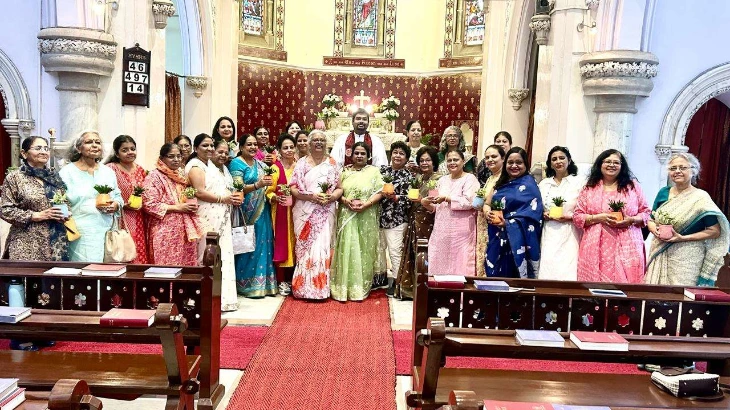
The Women’s Fellowship at All Saints’ Church, Jaipur, strives to create a supportive and empowering community for women, fostering spiritual growth and active participation in the church’s mission and activities.
Meet our team
Meet the hardworking individuals who keep our church beautiful, secure, and welcoming for all. From maintaining our gardens to ensuring the safety and cleanliness of our sacred spaces, we are grateful for their invaluable contributions.
